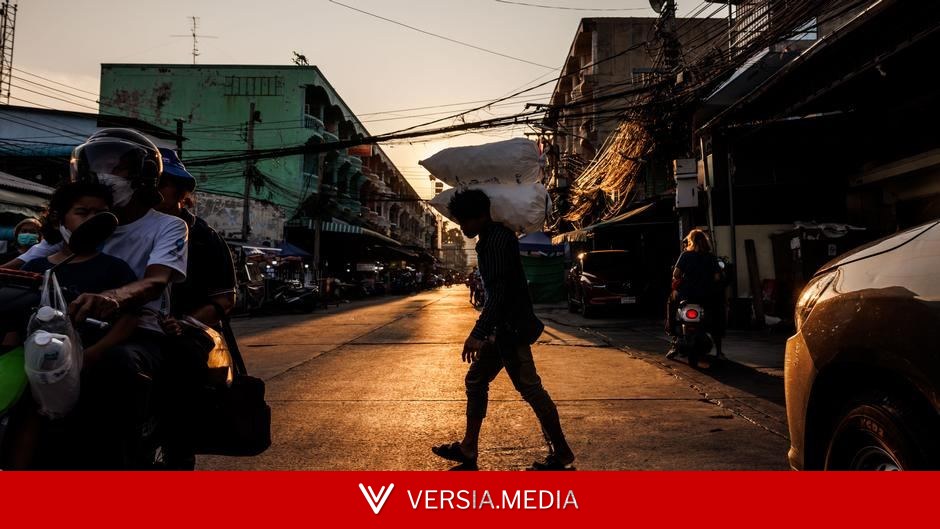
Hotter, drier weather is hampering rice and palm oil production as households throughout Southeast Asia contend with rising fuel, food, and transportation expenses.
Southeast Asia is preparing for a severe El Nino weather pattern as households and governments in the area find it difficult to address higher energy, transport, and food costs linked to the Iran conflict.
The UN weather agency, the World Meteorological Organization (WMO), anticipates that El Nino conditions will develop before August and persist until at least November. This will cause surface waters across large portions of the Pacific Ocean to become warmer than normal, and a shift in the typical east-to-west wind pattern is expected to bring increased heat to the central and eastern Pacific.
Southeast Asia is approaching the months when monsoon rains typically refill water reservoirs, cool overheated cities, and flood fields ahead of the next planting season. However, if the rains come late or are weaker than usual, farmers may postpone planting, reduce acreage, or shift away from crops that require substantial water.
"Southeast Asia's agricultural sector is particularly susceptible to a new El Nino shock, as its two main commodities, rice and palm oil, are highly concentrated and especially sensitive to climate irregularities," Jason Lee, chair of the Global Heat Health Information Network's Southeast Asia Hub, told DW.
"This extreme vulnerability means that what starts as a localized, farm-level disruption can quickly escalate into a broader, systemic food-price and inflation crisis throughout the region."
Rice, palm oil, and the inflation threat
For Southeast Asian countries, rice crops represent the greatest political risk. It is the region's staple food, closely connected to rural livelihoods, and is likely to provoke public outrage if its prices increase.
UN predicts record-breaking heat
To view this video please enable JavaScript, and consider upgrading to a web browser that supports HTML5 video
Rice is expected to be the most impacted staple crop because of reduced rainfall and heightened heat stress, Paul Teng, a visiting senior fellow in the ISEAS–Yusof Ishak Institute's Climate Change in Southeast Asia Programme, told DW.
"In rain-fed rice areas, there will likely be a higher incidence of localized droughts, and in irrigated rice areas, there will probably be water stress due to lower reservoir and irrigation levels," Teng said, noting that the most vulnerable countries are Thailand, the Philippines, Indonesia, and Cambodia.
The region could see a 2%–8% decline in rice output compared to a normal year, with larger local losses in drought-prone areas, he added.
Palm oil is the other major worry, especially in Indonesia and Malaysia, which together supply roughly 85% of the world's total.
"Palm oil is sensitive to the expected temperature increases, but unlike rice, the effects may be felt 6–12 months later from reduced fresh fruit bunch formation and oil extraction rates," Teng said.
Fertilizer and gas costs have risen sharply due to the ongoing war in Iran, and an extreme El Nino would push prices even higher, analysts warn. This has already led to increased food prices across the region.
Markets often react not only to actual shortages but also to the fear of shortages, driving prices up before harvest losses are fully known, Lee noted.
"This leaves central banks on high alert, forcing them to keep interest rates elevated to combat persistent, food-driven inflation at the very moment when regional businesses face higher borrowing costs and government budgets are already strained by necessary subsidies and soaring energy bills," he added.
El Nino threatens to make the world even hotter
To view this video please enable JavaScript, and consider upgrading to a web browser that supports HTML5 video
Economic storms on the horizon
Several Southeast Asian governments have already turned to coal to address energy shortfalls and introduced subsidies on food and basic services.
And the Asian Development Bank has reduced its 2026 growth forecast for developing Asia and the Pacific from 5.1% to 4.7%, with much of the blame attributed to the Iran war.
Philippine inflation remained above its target in May at 6.8%, while Vietnam's annual inflation rate climbed to 5.6%. Indonesia's headline rate is lower, but a 32% increase in some non-subsidized fuels has heightened cost-of-living concerns and put pressure on subsidies.
The economic impact is also unlikely to stop at farms or dinner tables. Temperatures above 40 degrees Celsius (104 Fahrenheit) would also affect the region's vital tourism sector.
A dry spell could also spark agricultural and peatland fires in haze-producing hotspots like northern Thailand and the Indonesian territories of Sumatra and Kalimantan.
"A big El Nino will raise the likelihood of serious transboundary haze. This will increase hardship among populations, where public health risks are heightened alongside other societal issues," Helena Varkkey, associate professor of Political Ecology at Universiti Malaya, told DW.
Haze also tends to strain regional diplomacy. Governments are often reluctant to restrict plantation activity too aggressively when farmers and companies are already under pressure from high input costs.
"Similar to when the COVID-19 pandemic coincided with haze events, governments may struggle to balance economic and social priorities," Varkkey added.
From climate shock to political pressure
For regional governments already striving to contain inflation, "this combination of a climate shock and a geopolitical war destroys their fiscal breathing room," said Lee from the Global Heat Health Information Network.
"Historically, across Southeast Asia, when the price of rice and fuel exceeds a certain threshold, public desperation quickly turns into political volatility," Lee warned.
The warning comes after a year of youth-led unrest and anti-corruption protests in several Southeast Asian countries.
In Indonesia, students rallied again in Jakarta last week against President Prabowo Subianto's spending plans and a fuel price hike, demanding lower fuel and food prices.
In the Philippines, an already tense standoff between the two main political factions has been intensified by widespread public anger over a massive corruption scandal, while Malaysia's Prime Minister Anwar Ibrahim has also raised the possibility of a snap general election if tensions within his ruling coalition worsen.
"Governments face the very real threat of mass protests, labor strikes in manufacturing hubs, and intense domestic unrest that can destabilize administrations and disrupt regional trade agreements," Lee said.
Forecasts can change, and governments still have time to secure water supplies, manage stocks, target subsidies, and warn farmers before planting decisions are finalized.
But the margin for error is shrinking. A strong El Nino, arriving alongside expensive fuel and fertilizer, could transform Southeast Asia's cost-of-living squeeze into the region's next major political challenge.
Edited by: Keith Walker